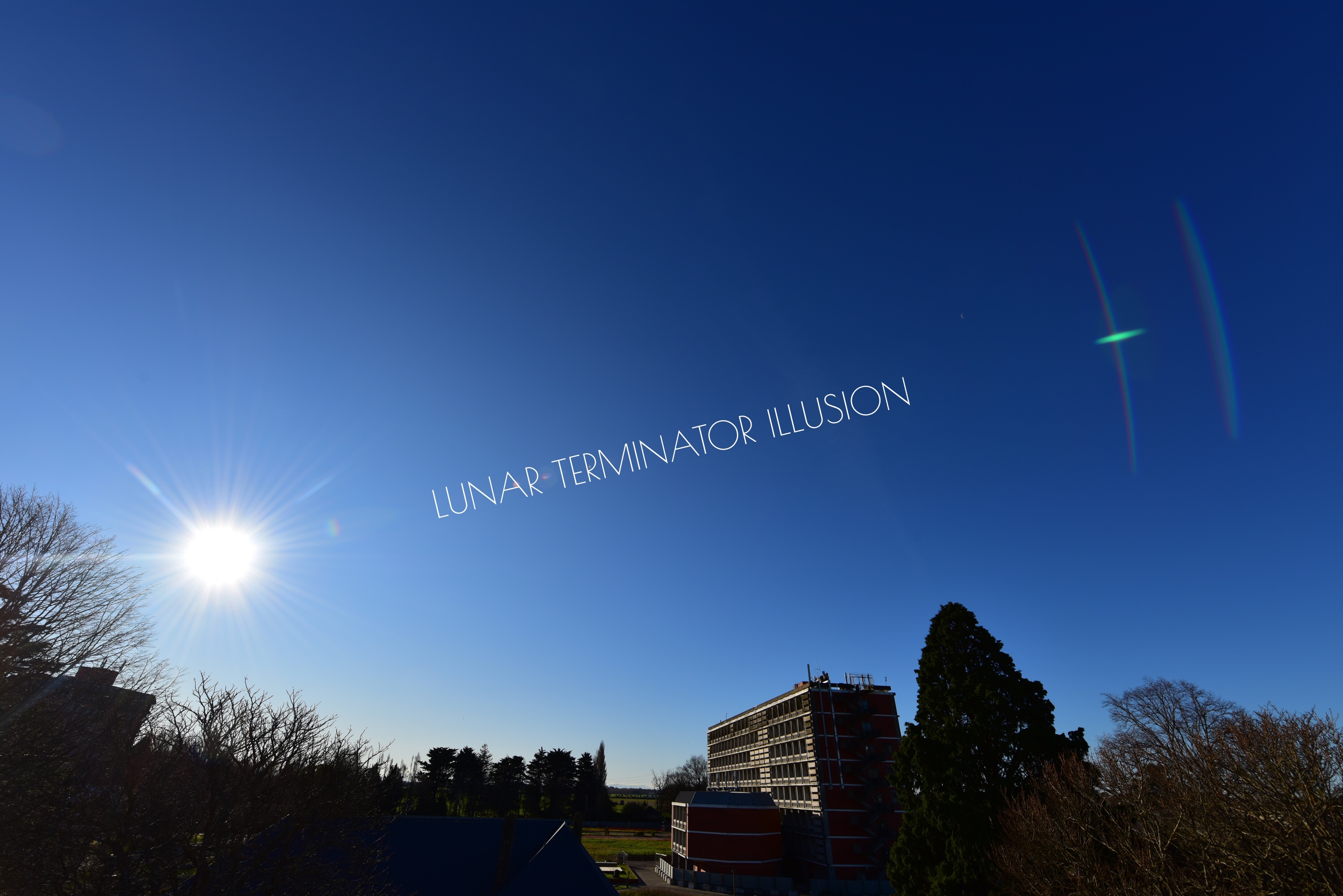
What exactly am I demoing today? For one, the nice weather of South Island that I miss already.
Do note that VSauce / Michael Stevens has covered this topic a while ago. I feel like pointing out that his video might be a better way to learn about what I am going to discuss below.
The cool thing is that you can perform this practically trivial observation on any sunny day near new moon.
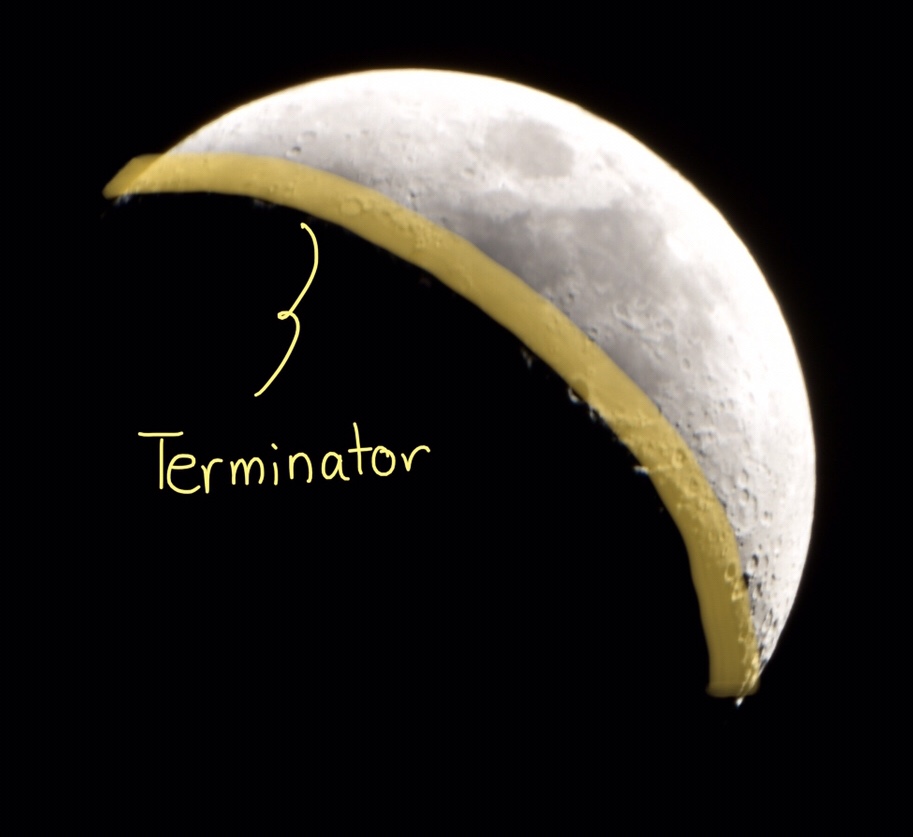
Let’s get the technicalities sorted first. The Terminator of a celestial object is the boundary between its day and night sides. For us on earth, the most iconic example of a terminator might be the outline of a crescent.
And now we can consider the main question. Whenever you have the moon and sun visible in the sky simultaneously, where does the moon’s terminator face?
Considering that the sun is the moon’s main light source, the lunar terminator points to the sun, of course. You might think.
On a wide-angle picture like the one below, you confidently draw the yellow line joining the centres of moon and the sun.

Then you carefully delineate the lunar terminator and extrapolate its perpendicular bisector (blue line) … and realize that they don’t coincide. What happened?

The short answer is in the name of the phenomenon — the mismatch is indeed an optical illusion. Well, it fools cameras too, as you’ve seen above, so it is not technically a raptile-brain-trickery, but a window into the nature of vision (no pun intended).
In this universe, vision — electromagnetic, acoustic, and so on — is the art of projecting (mostly) 3-Dimensional information into a 2-Dimensional perception.
To do so, our eyes are Perspective, or, to be mathematical, Projective. That’s just a fancy way of saying that all the light from the whole world need to be pointing towards a point (a small area) for them to register. This is different from the Orthographic projection that you probably know and love in geometry lessons.
Let’s look pay a visit to my trusty old friend, the Blender default cube, in both projection models, from the same angle.


Parallel lines in a perspective projection sometimes intersect, and in our world we use this fact to establish a sense of depth. In the sky, or any situation where there is no distance cues, this gift is taken away from us.
The sun and the moon live on a “dome” in our minds rather than the space with infinite depths. And the “straight line” connecting them appears indeed as a great circle on the dome.
The sky map corresponding to the pictures above might be able to illustrate this more clearly.





 Yourong Frank Wang