Category: Writing

  • Jupiter and Saturn, Night (-1)

    What’s special?

    Omitting the orbital technicalities by a great deal, a conjunction between Jupiter and Saturn (A Great Conjunction) happens steadily over history, and humans have been keeping track of them since at least the time of Kepler. From the perspective of the sun, Jupiter takes 11.9 earth years to complete one orbit, and Saturn 29.5 years. This means that they line up roughly every

    (29.5*11.9)/(29.5-11.9) 19.9 years.

    Conjunction has to be able to be observed on earth to count, and this complicates matter a bit further, causing the exact moment of each conjunction event to vary by up to a few months.

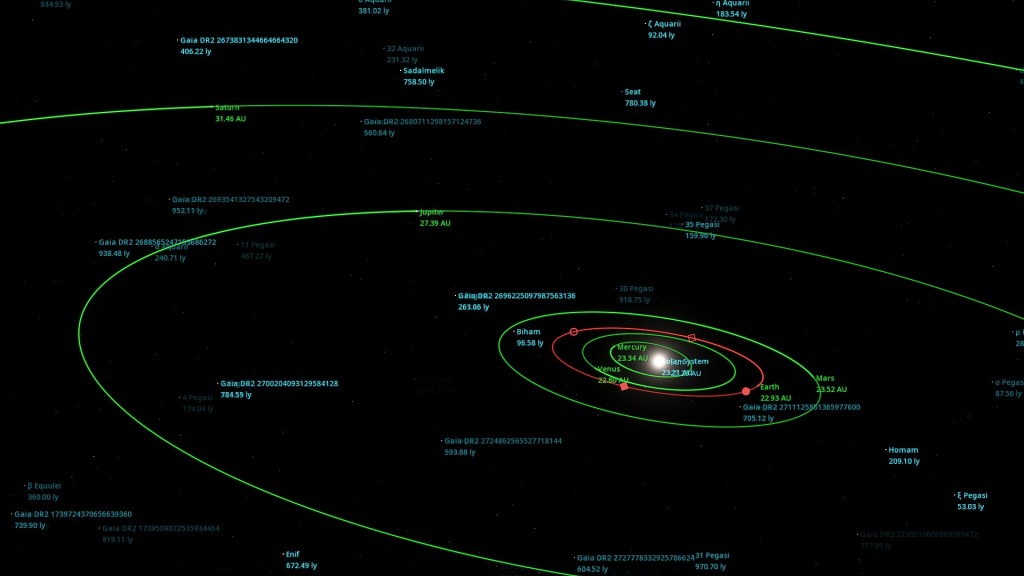
    From the perspective outside the solar system, we see that, when the two outer giant planets seem close together on earth, earth itself, jupiter, and saturn, almost coincide on a straight line, as illustrated below.

    A far-away view of the solar system against a stellar background of the moment 9am, December 20 UTC. The earth, jupiter and saturn are nearly colinear.

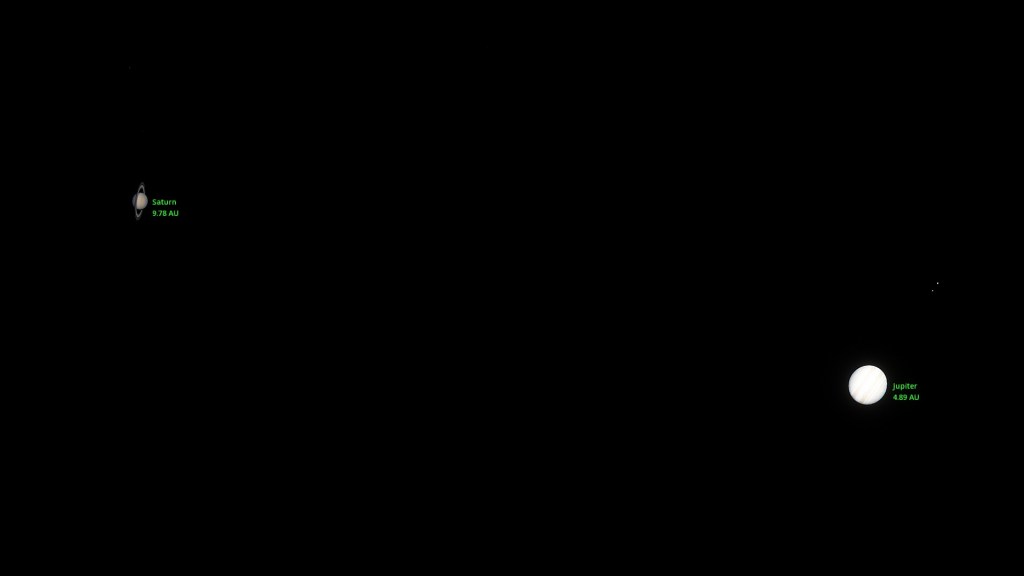
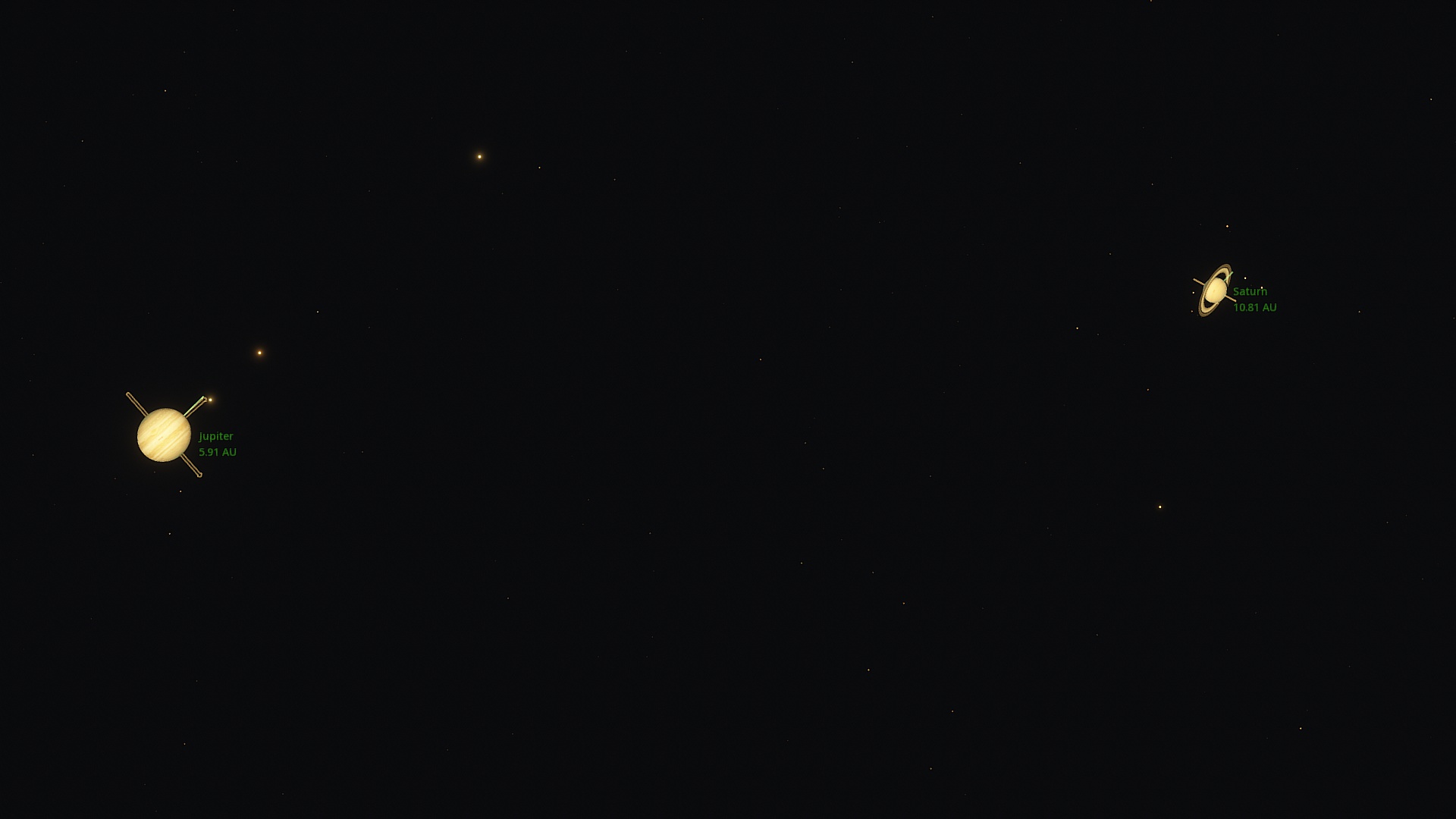
    In reality, this line almost always point near the sun, and hence the two exterior planets are rarely well-separated enough from the sun to allow for a good observation session on earth. For example, the last Jupiter-Saturn conjunction was May 28, 2000, but this happened behind the sun. Last time Jupiter and Saturn appeared this close was July 16, 1623 — this conjunction in the lifetime of Galileo also took place behind the sun, and hence was unlikely to have been studied. In short, the previous comparable event to the one tomorrow dates all the way back to March 4, 1226 [1].

    What the Great Conjunction of 1226 probably looked like. Rendered in Space Engine.

    For people with a telescope, the rings of Saturn and the moons of Jupiter can appear in your view at the same moment, creating a sensation that hundreds of millions of kilometres of separation giving way to celestial coincidence.

    WHERE TO LOOK?

    Below are some observation tips from NASA:

    Find a spot with an unobstructed view of the sky, such as a field or park. Jupiter and Saturn are bright, so they can be seen even from most cities.

    An hour after sunset, look to the southwestern sky. Jupiter will look like a bright star and be easily visible. Saturn will be slightly fainter and will appear slightly above and to the left of Jupiter until December 21, when Jupiter will overtake it and they will reverse positions in the sky.

    The planets can be seen with the unaided eye, but if you have binoculars or a small telescope, you may be able to see Jupiter’s four large moons orbiting the giant planet.

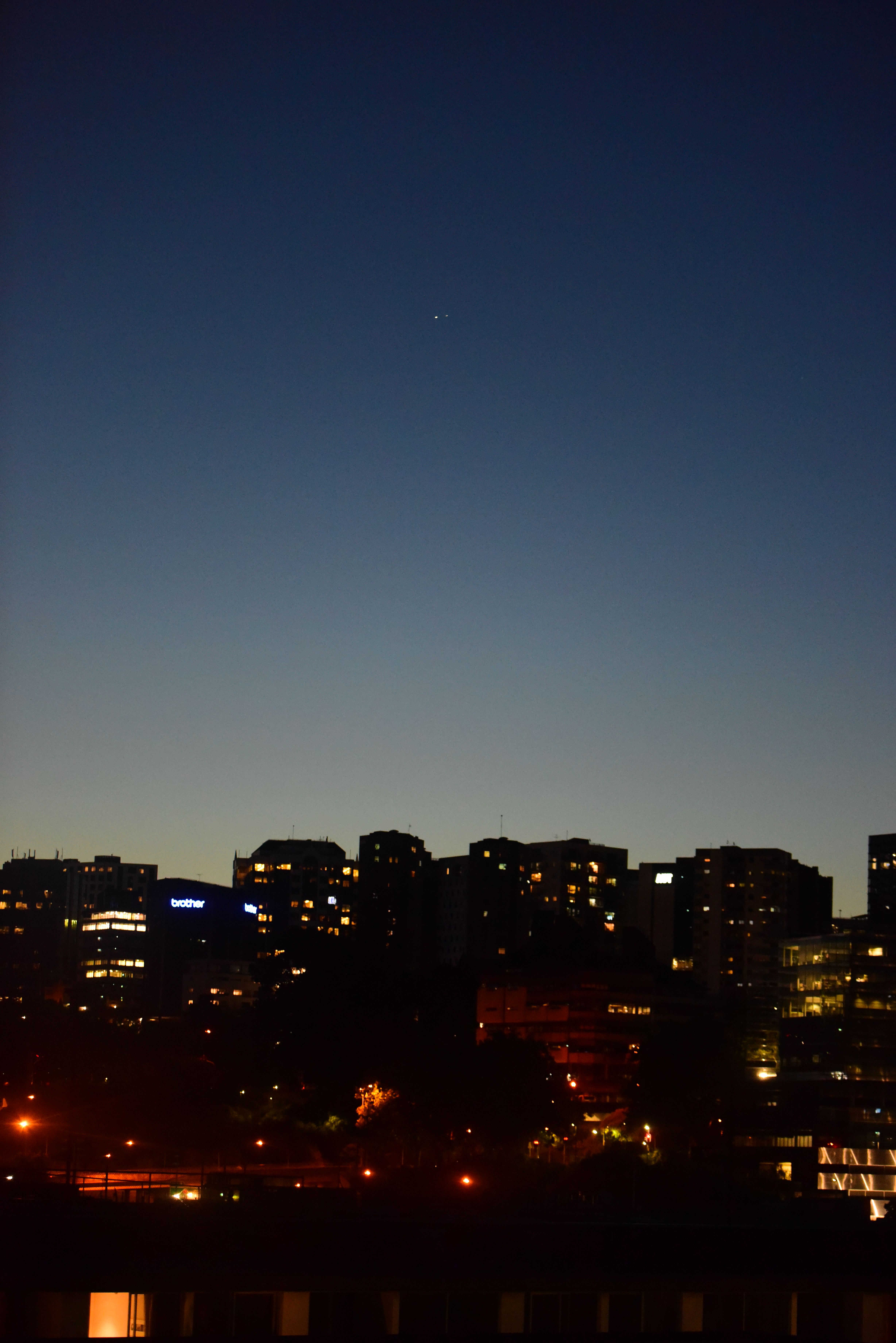
    And here are some preliminary results that I rendered / photographed in the night of December 20, 2020.

    References

    [1] List of Great Conjunctions between 1200 and 2400 AD, Wikipedia

    (Realize that back then nobody on earth was using the modern Gregorian calendar, so pinpointing the exact date is as much a historical venture as it is astrophysical.)


    And happy Solstice to my readers around the world. You probably won’t hear from me until 2021, so all the best in the new year. The hopes and dreams of humanity won’t just be put off by nature like this, I am fully convinced.

  • [Lux] Return of Sunspots

    A bunch of sunspots has emerged following the recent conclusion of the solar minimum. Quoting one of my astronomer friends based in Western United States, a powerful solar flare now would be a fitting end to 2020… To that I say, don’t forget backing up your critical data and communication lines.

    Anyways, here are two sun pictures taken between my teaching and office work this afternoon.

    Speaking of the sun, this is the beginning of the third solar cycle in my life!

    … And if you measure like that, human lives are comically short.

    The two sun spots are on the top left … the rest of the texture was caused by clouds. 200mm
    Sun setting behind Auckland CBD. 200mm
  • [Lux] Construction Conjunction

    In Series …
    Photo stories
    Artistic, scientific, social, or otherwise nontrivial moments that I freeze, served with related thoughts.

    The order of nature that we find ourselves developing from, is sometimes contrasted with the order that we strive to construct for ourselves after (and despite) realising the frequent lack thereof if one is ever not careful.

    I thank the language of physics for unifying my appreciations of both.

    …we give little thought to the machinery that generates the sunlight that makes life possible, to the gravity that glues us to an Earth that would otherwise send us spinning off into space, or to the atoms of which we are made and on whose stability we fundamentally depend…

    Carl Sagan, Introduction to A Brief History of Time, 1st Ed.

    In another recent note, 366 days ago, I turned in my honours / senior thesis, and wrote down the first paragraphs of my statement of purpose in hep-th. So much for that thought, but I am glad I kept going in physics.
    — And I got to sneak into the same mathematics office again in order to recreate a one-year-old photograph. Try the new slider widget below!

    What’s so bright in my eyes?

    The ceiling lamp.

  • One Try

    The idea for this essay came up during a discussion with one of my grad school referees after the 2019 season. Namely, if I so eagerly want to “save the world”, why study theoretical physics?

    The following essay was the first part of my attempt to answer that question… The rest, of course, needs to be in action.


    How are we sure, that Homo, our genus, is the maker of the first technical civilisation on this planet? This question persisted in my head, probably since my primary school readings of fiction and dubious mystery books.

    I thought I would (as a noble form of procrastination) outline a few facts that I believe supports the case that we are the first, and, quite probably, the last, to emerge from this planet to our current level of technical (and scientific) proficiency.

    Looking at our own past, some preliminary evolutionary considerations can be made. The environmental and thermodynamic conditions required for “intelligence” to be in favour was indeed rare. We owe our bipedalism, our properly placed thumbs, our sugar-craving brains, and the worlds we managed to shape with those gifts, to the K-T comet that cleared the stage for us long before our story, to the receding forests on the African highlands, to the frozen northern Pacific ocean, and to the tigers and lions that didn’t like the taste of monkey flesh too avidly … to name a few.

    I have to accredit Harari’s Sapiens, for inspiring most of those above personal notions — which might be a sign to you that my thoughts on this subject have been shallow and stagnant. Take my rumblings with a grain of salt.

    Still, the history of earth’s biosphere is way longer than the measly millions of years that the primates have arrived on stage. That much I do know. Time erodes a lot of things, including our trust in time itself. So, you might ask, longingly, maybe, could technology and science have happened to some entirely different branches of life than us?

    Well, we know of ants that make tools and farm aphids. But probably not.

    Other than the so-far general lack of archaeological footprints left by any long-gone technocratic societies, the most convincing observation, to me, is the (historic) prevalence of easily accessible natural resources.

    We found, happily accepted, and sometimes wasted, the surplus of earth’s carbon cycle over tens of millions of years (…oil and coal…story for another day). But our luck did not end there. For most of our early history, we had inorganic minerals in shallow caves, if not right on the surface. And that, to me, is a hint that nobody prior has seen much use in them.

    The laws of nature dictated that our societies progressed from[1] bronze to iron, i.e. against the reducing agent strength ladder. Often, after metal tools became prevalent, agriculture evolved on the massively expanding farmlands, and industry emerged with the express aim to produce increasingly complex or powerful tools. The logic might have held up to an practically exclusionary extent in our history — civilisation did not thrive at places that generally lacked minerals, even though many of those states did have excellently arable land and massive settlements.

    Today, far more iron-rich and copper-rich ores come from inhospitable or technically challenging environments than when we started mining millennia ago. Among other reasons, we’ve largely dug up the ones more easily within our reach. It perhaps stands to reason, then, that if humanity is to be wiped off the surface of earth in our current era, whichever species[2] that emerges in another million years might not have any minerals to use.

    They can siphon and recycle our rubbles. You think to yourself. Indeed, it might be sufficient, over geological timescales, for pulverised metropolis and dilapidated recycling plants to return some of their constituent metals to their natural state. But I doubt if this is good enough.

    To begin with, without obvious hints of the way forward, in other words, without a easily accessible experience through which the future foragers can understand why these shiny bits from the ground promises a higher level of productivity, it’s possible our tech relics become more of an ornament than a industrial resource, like humans had done with various cave minerals for thousands of years ourselves. Secondly, the metals we discussed so far are far from the whole story. I will present one example of the missing pieces to try to bring my arguments together.

    By this point[3], many of you might have heard of how Napoléon treated his favorite visitors with alumin(i)um cutlery, and only less important guests of his got gold plates. But today, less than 200 years later, I am typing this essay up on an Aluminum laptop keyboard, protected from some 6th-floor high wind by a presumably aluminum alloy window frame. What made this dramatic cost drop possible?

    Credit human ingenuity as you please, (and I probably tend to agree), but the fundamental drive might be this naturally occurring chemical, Cryolite (Na3AlF6). It readily mixes with aluminium oxide, and it significantly lowers the melting point of the latter. This mineral was mined completely dry from the face of the earth in 1987, by the way. Only industrially prepared alternatives are available for use since[4].

    The ability to synthesise cryolites is only a tiny node on human’s industrial expertise today, but once upon a time, discovering cryolites in nature, was the key for us to access the entire branch of aluminium-based technology. I cannot fathom how many little things like these played similar roles in our past, and how many achievements would have been impossible if those little factors weren’t here.

    I suppose that trivia like these make me appreciate the preciousness and uniqueness of our one try at achieving cosmic greatness. The chances we took to entangle our legends with the threads of our planet, the rare finds that we stumbled upon before we knew better, and the rivers we crossed[5]. But, at the same time, the likely outcome for our story to be followed by endless stagnation and sorrow if we fail[6].

    I remain optimistic, that progress in science and technology solves our existential threats, though slowly, sometimes backtracking, and not exempt from strifes and struggles. Depleted resources? We most likely can find alternatives. Dead end of knowledge, and, by extension, a lack of vision for the future? That curse is eternal.

    FW, 100 seconds before midnight.

    Footnotes and references

    [1] Other than the obvious omissions (tin, lead), there are also gold and silver. However, as they require little to no chemical changes to be useful, I would, subjectively, count them as something no more challenging than rocks.

    [2] Ant people and squid people look equally appealing to me. But again, the selection pressure on brains is a cosmically delicate thing. Boltzmann knows best.

    [3] My sense of how well people around me are in knowing and using science is heavily biased as I progressed through my own education and travelled to various institutions. This is just a general comment and I will probably discuss it in full next week, when my #DailyChemistry stored on Tencent Weibo gets permanently deleted as the service shuts down. Still, I need to point out that if you’ve come for the chemical engineering… You are reading the wrong blog.

    [4] Cryolite lowered the temperature required to get Aluminium via electrolysis from 2000 degrees Celsius to about 1000. From as much I can gather from my high school memory, the reaction is done in three scalable steps. You get HF by boiling Fluorites (CaF2, that glowing ore in Minecraft) in sulfuric acid. Then the HF is taken to react with an Al(OH)3 solution, after which the whole thing is heated in the presence of either NaCl or Na2CO3 to make the crystal.

    [5] Hi Carl.

    [6] I do not worry too much. Our ancestors have definitely taken risks like this before. On the wild grass plains, some humble animals, not the strongest, not the fastest, and without almost all ferocity, made it to become us, against a fate of extinction. Of course, my Bayesian philosophy suggest that luck might be independent between risk taking… Take good care of your nuclear button, if you have one.

  • [FW AdvLab] Basic Numerical Modelling with Python

    One of the latest lab manuals that I’ve developed for Auckland Physics. I find it potentially helpful for the greater audience of the internet.

    This manual is intended for second-year physics majors, and assumes little prior mathematical knowledge beyond single variable calculus.

    Keywords: IVP, ODE, Numerical Analysis, scipy