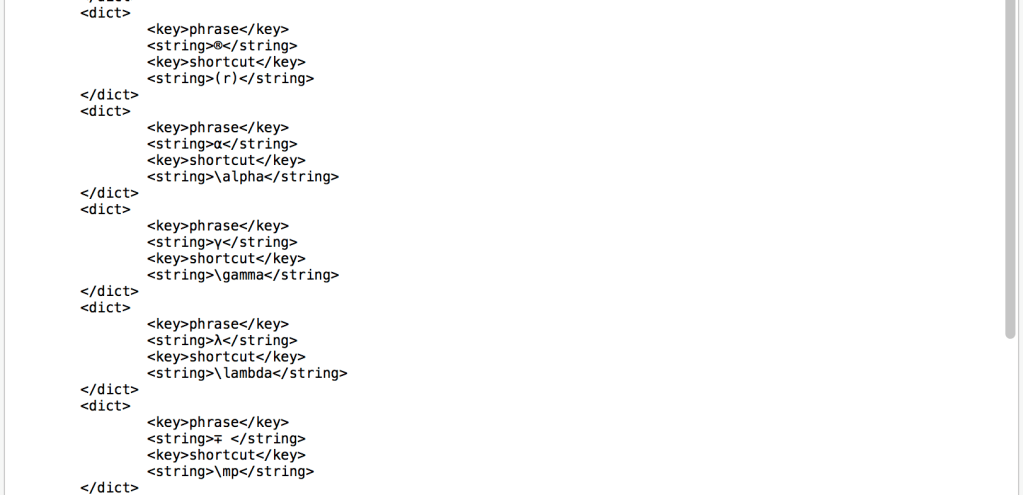
Some of my text-friends ask me how I can quickly type out mathematical symbols when we are discussing homework problems. Well, for one, I enabled the Greek keyboard on my phone, and then there’s this: taking advantage of the automatic text-replacement system built right in macOS and iOS.
To use this table, on iOS and macOS, go to “Preferences – Keyboard’ to access the shortcuts panel. And copy in the symbols along with their substitution text. It is admittedly an arduous process. You can watch this tutorial below.
For users of other computer systems, worry not. I made this chart collection to be useful, or at least, interesting for you too.
Note: Be extra careful when substituting dictionary words. Where convenient, do so with one letter altered. E.g. Map “therefor“ to “∴”, but never the dictionary word “therefore“.
Note: If your browser is modern enough to access my site, there should not be any problem loading the characters below.
As our initial release, I will tabulate the symbols straight from my own system preferences. A user’s entire library of text substitutions are actually stored in an Apple Property List (plist) file. I am working on a way to make a downloadable / loadable copy containing all my science symbols. But for now, you may follow the instructions below to enable your own selection of characters that are relevant to you.
Most Greek (and other languages’) symbols are omitted as you can easily access them via a software keyboard.
Collection 1: Common Symbols I Used in College Physics Homework
| Unicode Symbol | LaTeX Command (in Math Mode) | My Own Subsitution (Where Applicable) |
|---|---|---|
| ⋯ (1 byte ellipsis) | \dotsb | …. |
| ∙ | \bullet | .. |
| ⊗ | \otimes | (X) |
| ⊕ | \oplus | (+) |
| ⊖ | \ominus | (-) |
| ⊙ | \odot | (.) |
| ∵ | \downtherefore | becaus |
| ∴ | \uptherefore | therefor |
| ∫ | \int | integ |
| ∮ | \oint | ointeg |
| ∞ | \infty | inf |
| ∡ | \measuredangle | angl |
| א | \aleph | aleph |
| ¬ | \neg | neg |
| ∅ | \emptyset | { } |
| ÷ | \div | div |
| × | \times | cros |
| ○ | \bigcirc | () |
| ∪ | \cup | unio |
| ∩ | \cap | intersec |
| ∓ | \mp | -+ |
| ± | \pm | +- |
| ∀ | \forall | alls |
| ∃ | \exists | exis |
| ℕ | \mathbb{} | |N |
| ℤ | ditto | |Z |
| ℚ | ditto | |Q |
| ℝ | ditto | |R |
| ℂ | ditto | |C |
| ∇ | \nabla | del |
| ∈ | \in | belon |
| ∉ | \notin | nbelon |
| ≅ | \cong | congr |
| ≈ | \approx | almos |
| ≪ | \ll | << |
| ≫ | \gg | >> |
| ⩽ | \leq | =< |
| ⩾ | \geq | >= |
| ≡ | \equiv | ident |
| ≝ | ? | eqdef |
| ≠ | \ne | neq |
| ∂ | \partial | der* I learned German and regretted it pdv |
| √ | \sqrt{} | sqrt |
| ‰ | \perthousand | %0 |
| ∑ | \sum | summ |
| ∏ | \prod | prod |
| 𝒪 | \mathcap{O} | BOh |
| ² | ^{2} | ^2 |
| ∎ | \blacksquare | QED |
| ∤ | ? (divide: \mid) | ndiv |
| ⦜ | ? | rtangl |
| ∥ | \parallel | paral |
| ⟂ | \perp | perpen |
| ∦ | \parallel | nparal |
Collection 2: Physics SYMBOLS ADDENDUM
| ħ | \hbar | hbar |
| ℒ | \mathcal{L} | lagr |
| ℋ | \mathcal{H} | hami |
Reference Links:
Comprehensive LaTeX Symbol List: https://math.uoregon.edu/wp-content/uploads/2014/12/compsymb-1qyb3zd.pdf
OEISWiki, List of LaTeX mathematical symbols: https://oeis.org/wiki/List_of_LaTeX_mathematical_symbols
Wikipedia, Mathematical Operators and Symbols In Unicode https://en.wikipedia.org/wiki/Mathematical_operators_and_symbols_in_Unicode
 Yourong Frank Wang