Aug is short for August, and AUG in an mRNA is a “Start” Codon, where translation first begins, or where a DNA message commonly begins to manifest as an amino acid sequence.
On the one side, the 8th month of a Gregorian year was named after Gaius Octavius Thurinus (63 BCE to 14 CE), adoptive son of Julius Caesar and the first emperor of the Roman Empire (27 BCE to 480 CE, West, and 1453 CE, East). Octavius was remembered as “Augustus”, in Latin that means sacred, venerable, or majestic (?).
His calendar system, one that pitted number prefixes (Sept-, Oct-, etc…) against actual numbers, persisted to the day of the author, and is still widely used after some patches.
On the other, A, U, and G, in molecular biology, stand for three nitrogenous bases (nucleobases), Adenine, Uracil, and Guanine. The name “Adenine” was created in 1885, rooted in “pancreas” — ἀδήν “aden”, in Greek — the organ sample from which the molecule was first identified. “Uracil” was also coined in 1885, in an attempt to synthesize derivatives of uric acid. The molecule was then found in living things (yeast cells) in 1900. Guanine was isolated in the early 1840s, as a crystal from bird excrement, which was known in Spanish as guano.
For quite some time after their discovery, some of these molecules were merely regarded as funny nitrogenous ring derivatives, and some once a vitamin (which they are not qualified to be, as the body readily synthesizes them all the time), and their logical connection wouldn’t be clearly established until the early 20th century, where the central dogma proposed a main pathway of DNA expression. In this picture, A,U, and G, molecules, when properly attached to one molecule of ribose (which makes the duos Adenosine, Uridine, and Guanosine, respectively), form codons and anticodons in RNA, which make protein expressions possible.
That I am beginning my research career in a month that sounds like “Start” is about the most trivial thing I’ve ever set to discuss around here, but it’s a coincidence 2000 years in the making, which, like most things in life, gives me that sense of weird depth and wonderful complexity. Also I suppose it is a good (minor) detail to help pinpoint myself in the stream of history.
Notes and References
The time points of the Roman Empire were taken from Encyclopedia Britannica, while the meaning of Augustus was provided by the trusty Google Latin -> English Translate.
The stories of A, U, and G Molecules are based on the following book,
What exactly am I demoing today? For one, the nice weather of South Island that I miss already.
Do note that VSauce / Michael Stevens has covered this topic a while ago. I feel like pointing out that his video might be a better way to learn about what I am going to discuss below.
The cool thing is that you can perform this practically trivial observation on any sunny day near new moon.
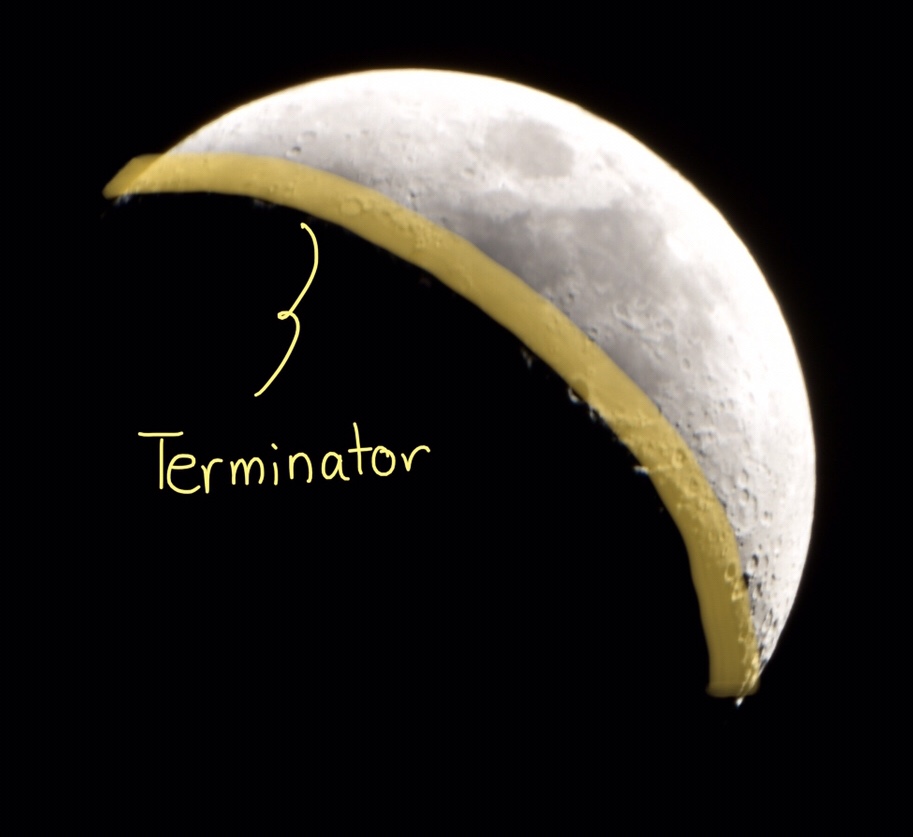
Let’s get the technicalities sorted first. The Terminatorof a celestial object is the boundary between its day and night sides. For us on earth, the most iconic example of a terminator might be the outline of a crescent.
Moon above Auckland City. FW, November 2018,
And now we can consider the main question. Whenever you have the moon and sun visible in the sky simultaneously, where does the moon’s terminator face?
Considering that the sun is the moon’s main light source, the lunar terminator points to the sun, of course. You might think.
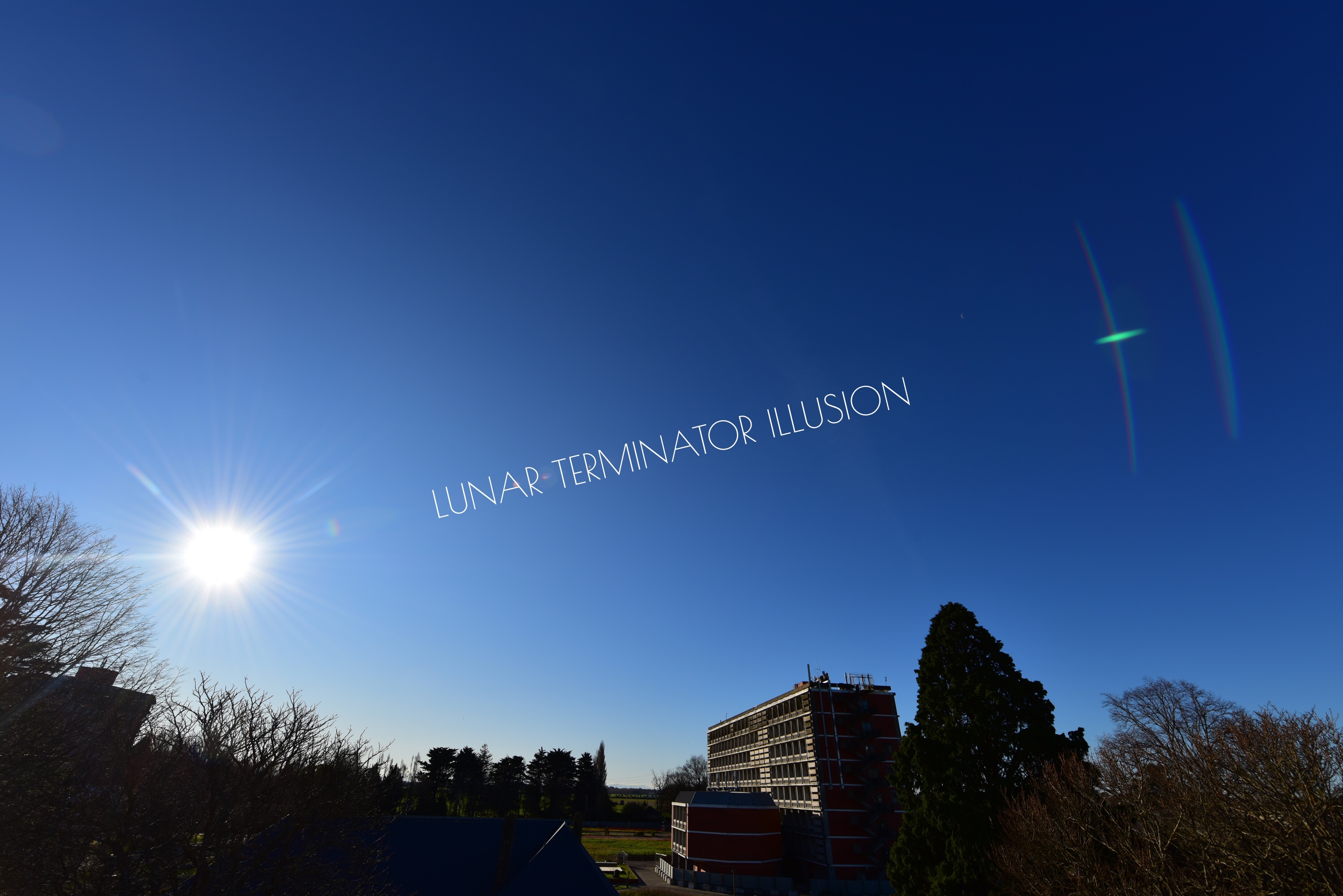
On a wide-angle picture like the one below, you confidently draw the yellow line joining the centres of moon and the sun.
(Please open in new tab if you need to inspect images more closely.)
Then you carefully delineate the lunar terminator and extrapolate its perpendicular bisector (blue line) … and realize that they don’t coincide. What happened?
(Same image, zoomed in)
The short answer is in the name of the phenomenon — the mismatch is indeed an optical illusion. Well, it fools cameras too, as you’ve seen above, so it is not technically a raptile-brain-trickery, but a window into the nature of vision (no pun intended).
In this universe, vision — electromagnetic, acoustic, and so on — is the art of projecting (mostly) 3-Dimensional information into a 2-Dimensional perception.
To do so, our eyes are Perspective, or, to be mathematical, Projective. That’s just a fancy way of saying that all the light from the whole world need to be pointing towards a point (a small area) for them to register. This is different from the Orthographic projection that you probably know and love in geometry lessons.
Let’s look pay a visit to my trusty old friend, the Blender default cube, in both projection models, from the same angle.
Perspective Cube
Orthographic Cube
Parallel lines in a perspective projection sometimes intersect, and in our world we use this fact to establish a sense of depth. In the sky, or any situation where there is no distance cues, this gift is taken away from us.
The sun and the moon live on a “dome” in our minds rather than the space with infinite depths. And the “straight line” connecting them appears indeed as a great circle on the dome.
The sky map corresponding to the pictures above might be able to illustrate this more clearly.
(Source: WolframAlpha. Image has been rotated to match the photograph.)
This passion project, along with my (remote) lab duties during daytime, has been my source of joy during quarantine.
I intend to use this page in a manner similar to my previous build logs of various crafts projects, and to upload pictures regularly as I make progress.
Basic usage of Simulink (R) for aerodynamic simulations… This is more “if” knowledge than “how”.
A deeper appreciation of the complexity of a real car. To be fair all I’ve been able to achieve is, physically, a metal box spring-loaded onto 4 bouncy wheels, and all the sub-systems are make-believe.






 Yourong Frank Wang