In Series …
THE APERIODICALS
Local (personal, potentially shallow, and subject to change) outlooks on science, technology, growth, and occasionally culture and history. The goal is to write something every week, but whether it can make its way to FWPhys is random. Hence the series title.
I guess I have had grown up?
Maybe?
Let’s have at it again!
This post is available as a podcast!
Nobel for the silicon teachers
This essay is prompted, first and foremost, by the news from earlier today (08.10.2024) that this year’s Nobel Prize in Physics was given to two (each with debates, sorry) pioneers in the study of artificial neural networks and machine learning.
Up to yesterday, myself and my colleagues were having a small round of bets on which physics field will get the medal this year — I’ve even readied my Dodd Walls Quantum Centre T-shirt in anticipation of an incentive to re-associate — but this outcome wasn’t even one of the options. It is loudly welcomed by the world, of course, as the news entails another much-appreciated boost into the current tech bubble, and underscores a widely-held but rarely-voiced epistemological view that the world is rapidly becoming post-human: human society, human science, human physics, should learn to live with such a tremendous and irreversible change.
As a dynamical-systems-versed researcher, speaking only about it as a mathematical interest, how far the study of NNs have come to change the world is remarkable. “We have taught silicon to think” — some optimists have phrased it — we distilled a functional model of how the biological brain organises information and scaled it up beyond the human grasp, and now our world inextricably runs on it. AI-generated information, from electoral up to su-romantic, floods the conscience of people around us, and quietly but steadily dilute the marks that humanity left on the world, digital, imaginary, and physical.
To most of us not in the sight of an auto-aiming auto-life-detecting bomber drone, the process might not involve high-calibre rounds or explosives, but it’s an obliteration.
Anti-Auto-Recommendation, Revisited
This subsection’s title is the same as an 2019 blog post here on FWPhys (which I purged in the Great 2020 Site Cleanup), where I strongly voiced my personal opposition to the practice of canning the human experience into standard portion servings, further, the practice of labelling them “content”, and ultimately, serving them using algorithmic curators and infinite scrolls — both of which are not incentivised to respect and value human wellbeing.
That’s pretty much it without the 2019 FW Ramble. I am rather proud I stayed mostly consistent. Texts and buttons such as “You might also like …” and “Autoplay” have had no impact on me except when I am discovering new music. YouTube front page is the exception I guess. It is too useful. I do feel what I listen to and watch there go all over the place over the scale of weeks, as if gently nudged by that glowing button called “New to you”.
Now of course what I am even more annoyed by is Facebook’s autoplaying video thumbnails, which intelligently detects when “things happen” and keeps the video looping just before that to prompt you to click that. They have programs — AI’s — watching everything, and determine with great success, what a human wants the most from each video. Cool.
Sorry for the distraction. I hold the same feeling overall about auto-recommendation, but I, having advertised my photography service a few times on Meta and Google, now see beyond that, perhaps just a bit.
An alternative title I had for this section is Trans-Human Capital. I am less enthused and knowledgable in class struggles than I perhaps should, but the following has always remained to me a vivid picture that after a total biological wipeout on this planet, all that remains are algorithms trading with each other, growing the numbers they are told to grow, in perpetuity. Humanising them maybe, but what could that money buy?
Last month I spent a night awake and wandering in Lower Manhattan, where the feeling is more pronounced. The creation and guarding of a great amount of wealth involves no — maybe negative — attention to the humans. I walked past two homeless tents on Wall Street.
History lends inappropriate amounts of power to inappropriate people all the time, that’s nature, that’s humanity, in that they become appropriate.
That said, in this current round of power struggles — which with all that I’ve smelt are perhaps one of the final struggles — without consent, we hand over the world to tech bros, algorithm grifters, and advertising platforms.
Such an inglorious way to exit the stage, huh?
Wildlife Crossings
It isn’t a new idea that humanity’s true position on the history of the planet might as well be to beget the next evolution stage of something™ (life?) more dramatically different from ourselves than even the cyber-punk transhumanists dream of, a new type of idea-carriers — idea-makers — better suited to thrive in and venture to the hostile Cosmos. This has happened all the time before we got to ride the wave, ask the eukaryote cell, lunged fish, and early primates before us, but transitions of intellectual dominance never happens peacefully.
We seem to collectively remain fuzzy of that part.
To concede being second best, on a logarithmic scale, soon, is to yield control — not that we were very good at it anyway — over how our resources are rationed and balanced. It is that we give up the prospect of ever fully grasping the nature of self and existence, not even knowing how far we had truly come or how much there was left to go — now we become trivially different from farm animals to be appeased, and knowledge of such — knowledge at all — will soon become redundant.
One real life scene I sometimes overly lament is a fly trapped by glass, usually an ajar window. I know it is perhaps not possible on a human scale to tell it how to avoid glass, let alone understand what it is. Then I become nervous whether for ourselves there exist similar glass panes.
Thanks to my upbringing and personality I do feel passionate about education. A fundamental passion, but also dramatic unease about it. To see that students grow up and go on and do their own things on their own volition is among the best feelings I have ever experienced. But now — as I am no longer myself legally a student, and as the world changes with new ways things work every fortnight — I farewell my students to grow up in a changing world, one that may soon be beyond us.
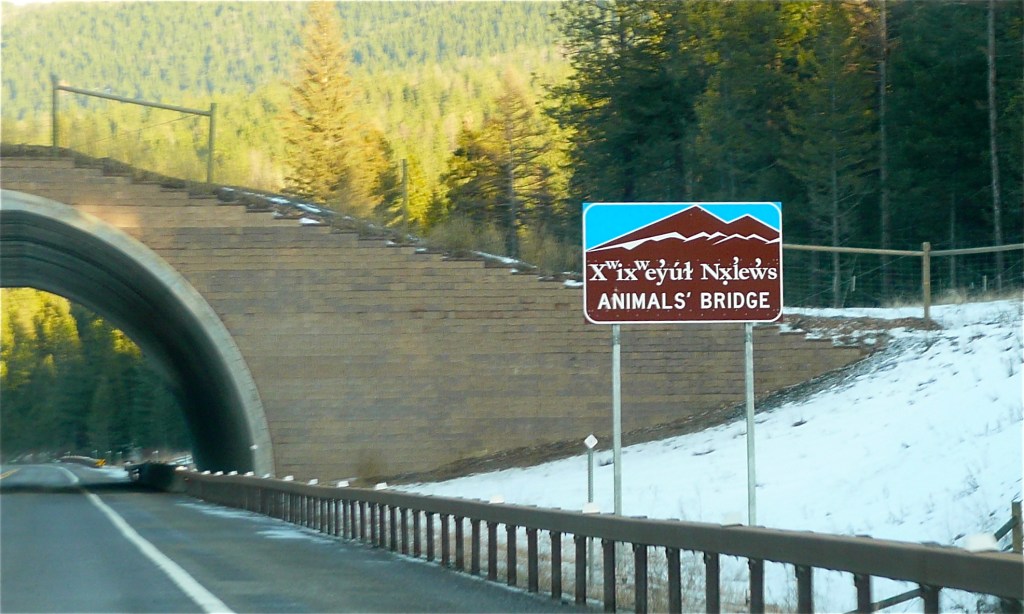
I think about the bridges built for migratory animals. Wildlife Crossings. They are used in North America, Central Asia, and beyond. I always felt it is a miracle that migratory animals actually use them to cross major highways and railroad lines — but I guess the pain of being hit by a car stands largely independently of knowing how internal combustion engines work, or how to make billet steel. Wildlife crossings are often seen as a nice gesture through which we — the intellectual pinnacle of the biosphere — look after our “less-knowing” brethren.
Apple engineers (who bought the original Multi-touch patents elsewhere, I always need to make it clear) sometimes regale at the first times they bring their prototypes home to show to their children. “It is so natural!” one would say, watching their 2-year-old daughter slide to unlock for the first time.
I have had my first touch screen — the iPod touch 2 that I still own — when I was 12. Luckily I had already begun taking physics, and additionally reading about how capacitive touch worked wasn’t too far off of an order. It was the age when the operating system was still free to be jailbroken and explored, showing a young middle school kid the wonders of UNIX. In 2020 I even wanted my own lab students to build models of the capacitive sensing themselves until the lab organiser pointed out to me people with that level of enthusiasm and competence usually go study at another faculty.
I used to think having a touch screen device is the luxury. But increasingly, I realised I was wrong. Caring enough to understand how it works is the actual luxury.
The touch screen, as a symbol of the entire infrastructure our “screen generation” is raised by, is our wildlife crossing. A barrier beyond which many individuals — if not careful — are eternally separated from a chance at understanding how things work.
And to me that’s a terrible way to grow up.
(Cover image: a bridge for wildlife in Montana, USA. By Djembayz, CC0.)
 Yourong Frank Wang