
Waterloo included, I (re)visited many spots of importance to my career on my recent journey, and have connected with, grabbed lunch with, or otherwise disappointed, quite a few friends and colleagues in North America.
What I feel like making my next remark on — before hitting Twitter with “NEW PAPER”, and not for my signature surreal comic shock — is that few of the interactions had as much impact on my state of mind than the sight of an unclaimed baggage area at San Francisco International Airport.
After Canada, my suitcase spent some more time in YYZ (Toronto Pearson Airport) than myself. United called me to pick it up after it arrived some 25 hours later.
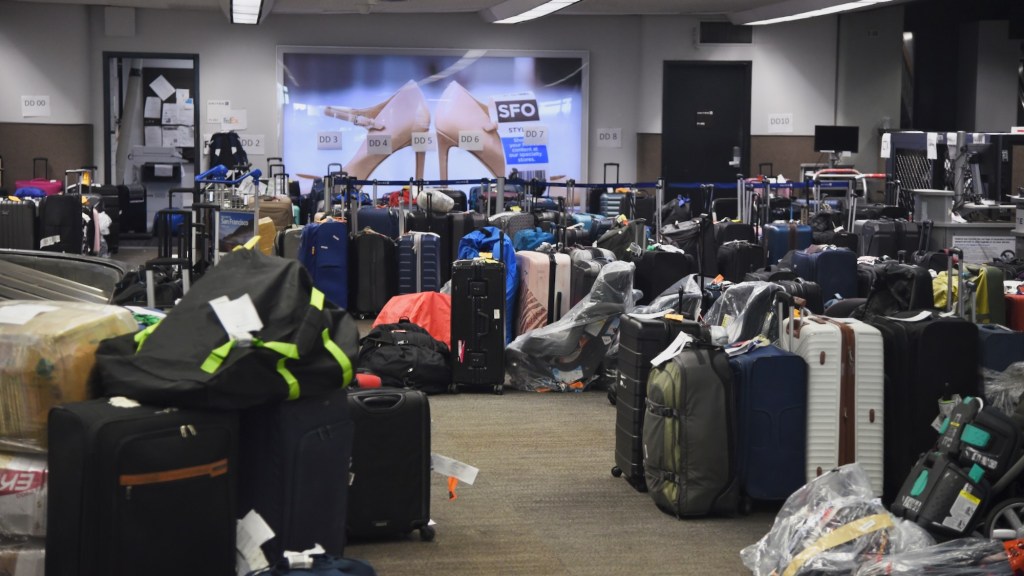
That was when I saw the size of their baggage team’s operation at SFO. Behind some cordons and curtains, the rate at which unclaimed suitcases piled up throughout the day, and the sheer number of journeys this kind of low-probability event poised to impact …
My immediate feelings and speculations elude me, other than finding it fortuitous to be hit with this on the final leg of my journey, for which I already planned some slack. Nonetheless, it kicked into motion some long threads of thoughts and self-reflection.
YYZ and SFO are both busy airports, with traffic arguably beyond easy comprehension. Soon to float up to my mind were my nebulous impressions over the years about industrial operations and risk management, stuff in the background that keeps society working even when things go wrong.
This is a much needed reminder to accept the existence of imperfections, and to work to resolve it; airline companies stay in business because they have systems and personnel in place to deal with mishaps, not despite them.
Since my undergraduate days, I would habitually shout “deal with complex systems”, or “don’t forget how big the world is”, the latter being FWPhys’s 2019 tagline. This has unfortunately stayed on the surface. I didn’t do enough.
“Taking things for granted” is a learned attitude not natural to the human condition, and I find myself described by it rather aptly. I like simplified models and isolated systems as much as the next theorist, but a recognition seemed to have escaped my vision that they aren’t everything.
Massive enough amounts of neutral hydrogen eventually start to talk — as we are now — idealistic models floating in free space can only take one so far, and, as recognized by Sagan et al, the universe has no obligation to do what we expect.
This has been as much a physics memo as it is about a change to my world view — to embrace the complexity hidden shallowly behind the mundane aspects of our lives, and to relegate some peace of mind to the occasional ignorance and chance.
Risk can be as cold as a number or as real as life and death; on this spectrum my latest experiences with it aren’t remarkable at all, except in what it taught me.
Physics is never a refuge from the messy and chaotic world that we wake up to; rather, a sound training in physics is the armor with which I stand to face the world, and perhaps change it.
More is different1,2, Watson.
P.S. It’s also 1000 days today since I last backed up my MacBook.
 Yourong Frank Wang