I don’t know whether I am taking the best angle about this topic.
Anyway, here goes.
In Series …
THE APERIODICALS
Local (personal, potentially shallow, and subject to change) outlooks on science, technology, growth, and occasionally culture and history. The goal is to write something every week, but whether it can make its way to FWPhys is random. Hence the series title.
Growing up, I assumed that both motorsport and cinema were some of the exclusive games for the very few at the top — games of stars. Formula One, on the television of my childhood, was Michael Schumacher’s scarlet blur streaking across corners; in my teachers’ and parents’ memories, it was Ayrton Senna, fearless and tragic. Hollywood, too, seemed ruled by names large enough to decorate the posters, as though directors and actors alone carried the weight of entire films. The talent at that level was undeniable, but the belief that these worlds belonged only to their stars was one of my earliest misapprehensions.
That certainty began to loosen the first time I stayed in the cinema after the lights came up, watching names scroll long after most of the audience had departed. This was before mid- and post-credit scenes became standard: for me, it began as a family joke. My mother urged me to “spot the accountants and tax agents,” especially in international productions with multiple locations — the importance and complexity of financial reporting seeped into me almost by osmosis. Then watching credits became a habit. Later, with a friend sending CVs to Dolby and Lucasfilm, and myself once submitting a thin résumé to Wēta, those walls of names felt less like bureaucracy and more like possibility. Possibility of connection and recognition: perhaps one day I’d spot a familiar name, or even my own.
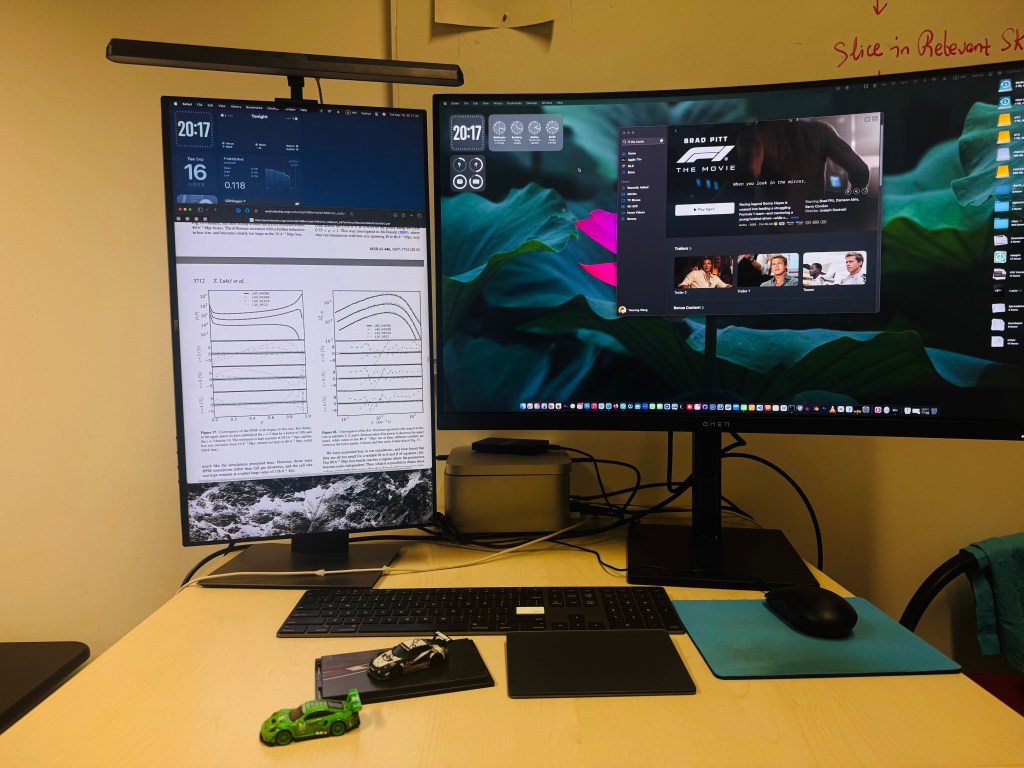
I finally watched the new Apple-produced F1 movie today. I had missed the local cinema release, thinking screenings in Germany were all dubbed in a language I only half-understand… A regrettable decision I’m glad to have corrected, though I still look out for a chance to see it on IMAX. A strong artistic choice in the film was to begin with an underdog team. Of course, “underdogs” in Formula One are a special breed: even the slowest rookie has probably seen a hundred million dollars and a decade of their life burnt to be on the grid. Yet that is what makes the contrast compelling — that within a pinnacle of exclusivity, there still exists hierarchy, struggle, and the drama of those who fight not to win outright but to belong, to finish, to prove themselves against giants. The drama often came from making a difference at the margins. A pit crew making a fast tyre change. A new aero tweak shaving a tenth of a second. A strategist calling the right pit stop. A rookie driver just finishing a race in one piece. And so on. That’s the human-scale story: even in the world’s most elite competitions, small parts matter.
In all, the movie — production, story, and context — solidified what I had sporadically sensed, but had previously rarely put into meaningful words: both racing and film are less star vehicles than ensemble dramas. They are stories of people, in the fullest sense. Behind every podium finish or Oscar nomination are the technicians and engineers of all ranks, communications teams, corporate managers and directors, and unseen collaborators, confidants, or contrarians who collectively shape the spectacle.
Perhaps this is why the credits screen matter to me. They remind me that this world hosts a collective existence of people who do things. That someday my name, too, could scroll somewhere — not as a star, but as a consultant, a technician, a bridge between science and art. As one who lived in my time, experienced, thought, made a difference, and inspired others to do the same.
(Cover Photo: the movie desk cars … Matchbox Porsche 911 RSR (991.2) and Hot Wheels Porsche 911 GT3R (992.1))
Update: F1 CGI Behind the Scenes https://youtu.be/mmAxzrIgVcI?is=oPKcWEA2hYEplU88
 Yourong Frank Wang