
To people to whom I sent this link … The restart of Photo Journals marks a profound pivot of my online presence and the next stage after my full withdrawal from Meta products and Twitter. Dramatically less content but each post slightly more thought through — also, nothing from mobile.
I hope you like it.
Content Warning: this essay is about a visit to a public cemetery.
Format Notice: this essay is derived from transcripts of a recording I made while taking this walk. This is why I seem to be changing locations as the essay progresses.
I have pondered the following question before. I might have expressed it in an earlier blog post, recalling my drive to Ithaca, New York, without having booked any firm meeting with a peer at Cornell. A morning much like this one, spent in solitude by the grave of Carl Sagan.
Before I came to Europe I thought, half in jest, that I would resume and amplify my thread to visit the resting places of people whose work shaped my world and myself. Well, I am here now.
Now, is it out of admiration, or insecurity, that I do this? Am I seeking connection, or reassurance that my own legacy — yet to be defined hopefully — will not be forgotten? Do I stand at these graves to honour their memory, or to calibrate my own projections of them—to measure myself against them? Am I so insecure that I feel I am only guaranteed attention and coherence in front of a mental projection of someone long gone and paused by time?

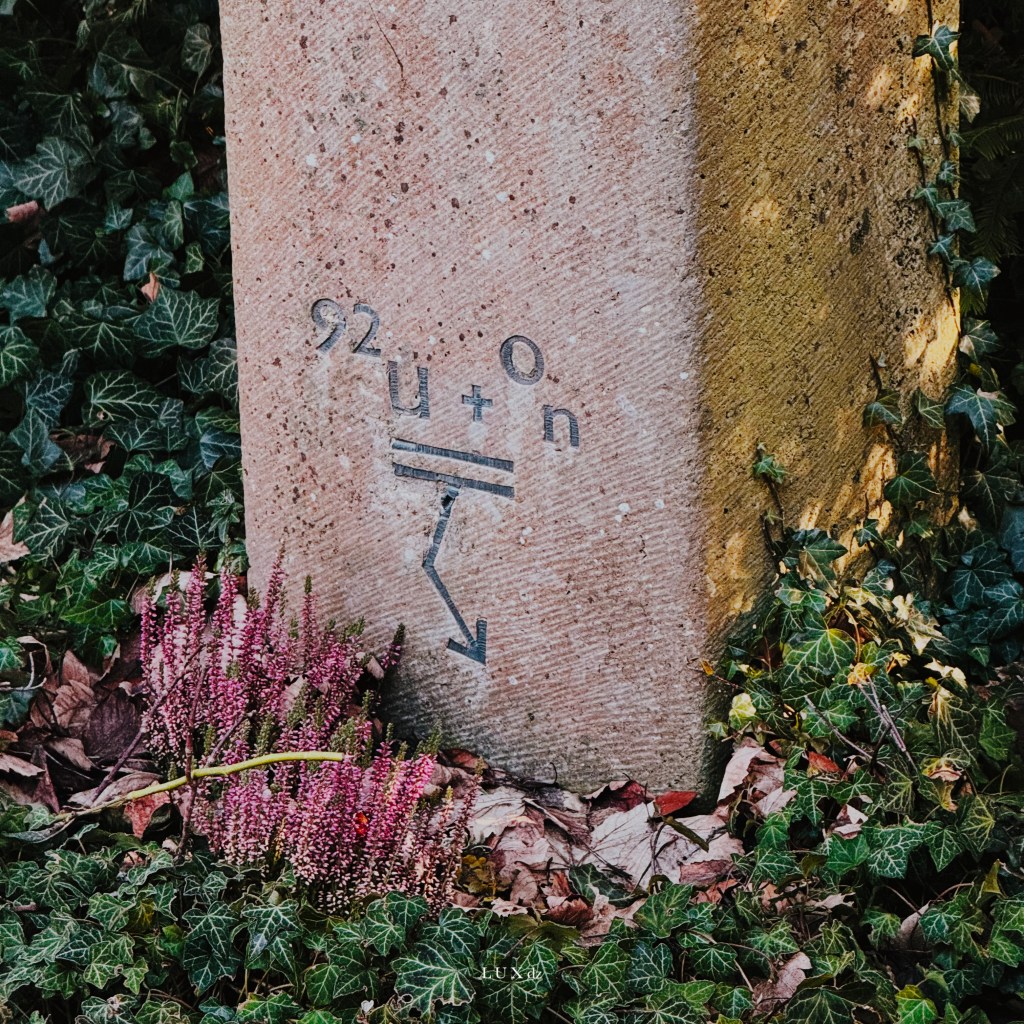
There is something unsettling about the permanence of a tombstone, or just generally of a name carved in stone. A finality that awaits for me up ahead as well.
And yet, I remind myself: I still have time — not enough time if I insist on worrying, but plenty otherwise.
There is no reason to give up trying.
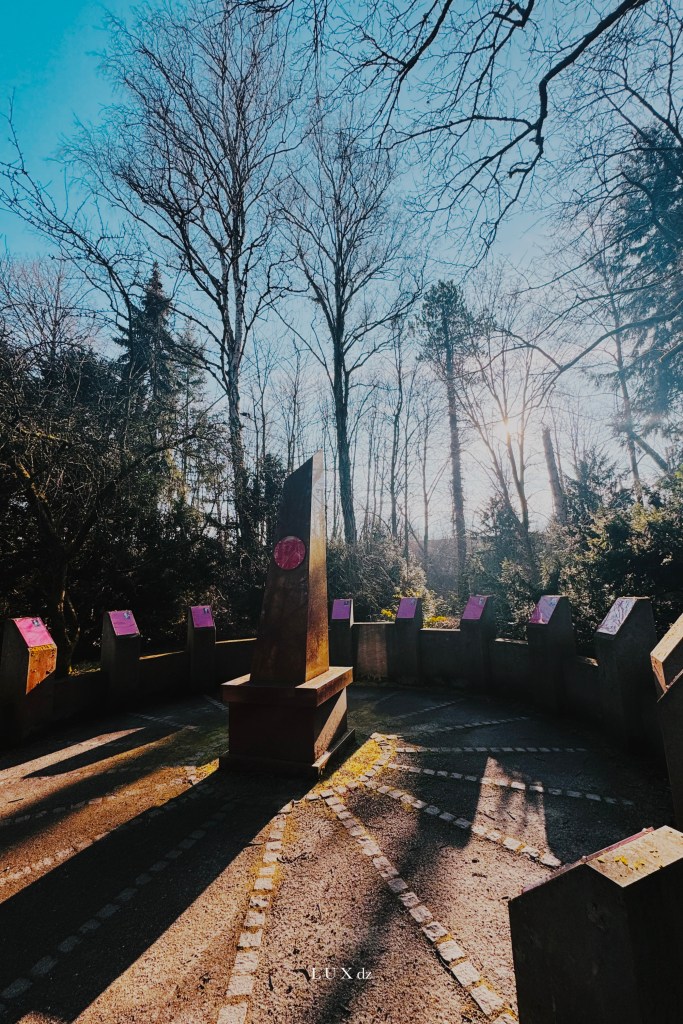
Today’s visit is motivated, in part, by nice weather, but also by my own work threads—this week I am writing questions for general relativity, thinking about Schwarzschild, whose name I will, of course, be invoking frequently. He was the first to solve Einstein’s field equations for a point source in general relativity. Others after him developed the theory further, coined the term “black hole”, refined coordinates, proved uniqueness, extended interpretations—but he was the first to see that the equations permitted such a solution.
His life was cut short on the battlefields of World War I. He was, at some point before that, the director of the Astrophysical Institute in Göttingen — where I now work — the city remembers him operating the big telescope that decorates the skyline. There are connections between him and myself on this planet—not in some higher-dimensional space, just here.
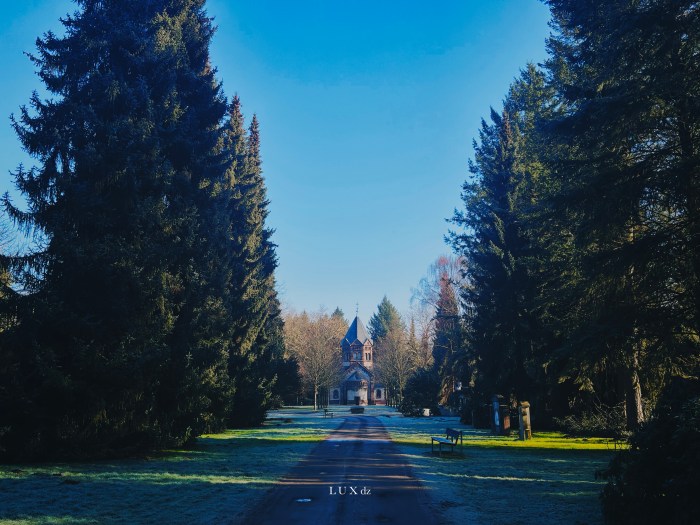
I walked for a while and realised that FindAGrave might have some information. It did, and I set my navigator to take me there.
To think I am an active part of my generation of science — I need a reminder — I have not yet pushed my current work far enough, or at all. I feel content offering mentoring and going to conferences. There are a few on the horizon. But beyond that?
This week I rescinded my registration for Solvay Institute GW Astrophysics workshop in Brussels later this month. If I say I go to a conference to familiarise myself with an adjacent field, look—I’m wasting funds and time, and overlooking the much more pragmatic solution of just reading their papers.
For me to realise such a thing is more momentous than it appears on the surface. I have very slowly learned not to subscribe to “just be there” as a philosophy of life.
Well, I am just here. Feeling how it works, and trying to understand it. Trying to understand myself. In that today becomes meaningful, I guess.
In moments epitomised by trips like this, there is too much stirring in my own head and guts to reliably translate my motivation into solid work put out into the world. Anyway, when I am “motivated”, does that mean higher capability or lower standards?
Am I to know the difference?

The one thing I work hard towards is a reconciliation of different threads within me to derive a uniform and stable motivation and concerted, consistent efforts. And it’s not trivial. And I do not believe just being there, passively attending things, mind and soul stirring maybe, is a good way forward.
2025 will be a defining year. I probably have said something similar about 2024. But I remember when the calendars turned last time, I was thinking about becoming a video game artist more than continuing with computational cosmology. And now I have come to the realisation that having this position—be it for the sake of being here, for the sake of just being able to publish, to read, to have access to databases, to have observation time on telescopes, to have big data storage—I do not cherish my position enough. Shame. Still time to change, right?
I say, no matter what, I’ll carry the fire. Yes, I derive great joy from teaching general relativity. But am I seeing it the right way? Is this enough?

Anyway that was when I found it. The internet was correct. It’s the grave of Karl Schwarzschild and family. And of course, on top of the grave is the celestial sphere.
I don’t need to stand there for long. I’m not here to just be here. And since we are physicists, I brought you an orange — don’t mind if the living one has it.
But thank you for your work for humanity.
 Yourong Frank Wang
One response to “[Photo Journal] Notes on my way to the Grave of Karl Schwarzschild”
What I completely left out in the post is that i read Frost and Fire last night. In this 1946 short story by Ray Bradbury, a distant descendant lineage of humanity is exiled to (crash landed on) an extreme planet. Through evolution and biotech (which they then lost, of course!), life is accelerated to the extreme to cope. People’s hearts beat at 1000BPM, and everyone lives and dies within eight days. In that society, a clique (and later clan) of scientists would remain, spending 3 days to learn everything before, a few hours to perform one calculation, then retire and die.
It’s a rather direct allegory of the human condition. I don’t see why our world is any different. The thread of thought ends here, and it’s up to the reader to see how it also informs my vision on the bygone scientists.
LikeLike